
Table of Contents
Over 200,000 Americans woke up on Wednesday morning frantically searching Google for three words: “habibi meaning”. The viral cultural phenomenon was triggered on election night in Detroit, Michigan, when newly elected U.S. Senator Dr. Abdul El-Sayed delivered one of the most memorable, witty victory speeches in modern political history.
- ‘Habibi’ (حبيبي) Meaning: Literally translates from Arabic to ‘my beloved’ or ‘my love’, but colloquially serves as ‘my dear friend’, ‘buddy’, or a polite conversational term of endearment.
- The Viral Punchline to JD Vance: Addressing Vice President JD Vance after a hostile campaign, El-Sayed quipped: ‘JD, habibi, there is this delicious irony in the fact that you’re constitutionally obligated to swear me in in January.’
- Historic Milestone: Dr. Abdul El-Sayed officially won Michigan’s U.S. Senate election, becoming the first Muslim American ever elected to the United States Senate in American history.
- Clapback to Donald Trump: Following repeated campaign jabs over his heritage, El-Sayed added: ‘I know you struggled with my name… after JD swears me in, you can just go on and call me Senator.’
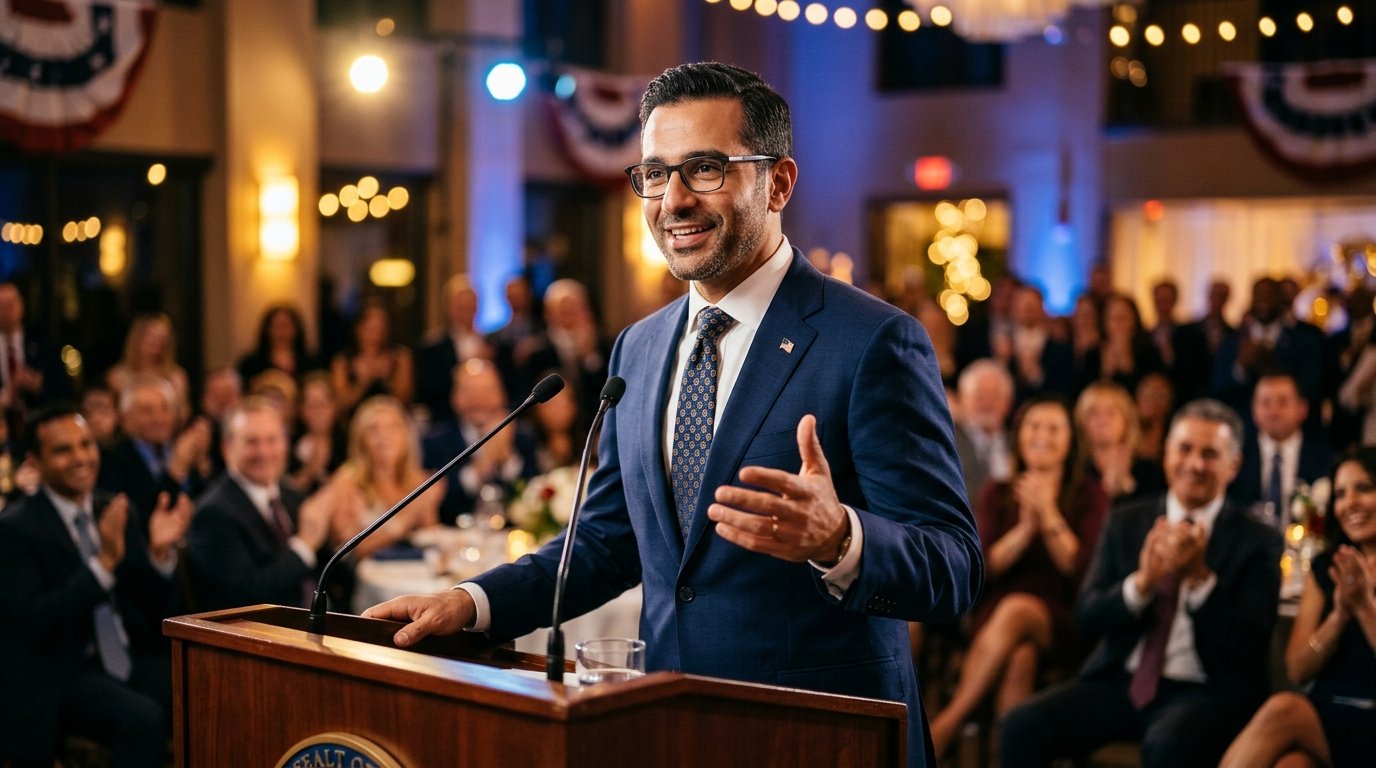
Dr. Abdul El-Sayed addresses supporters in Detroit after securing Michigan’s U.S. Senate seat, becoming the first Muslim American senator in U.S. history.
The Speech That Broke the Internet: ‘JD, Habibi…’
Throughout the hard-fought 2026 Michigan Senate campaign, Abdul El-Sayed was targeted by conservative political attack ads questioning his cultural heritage, faith, and progressive public health policies. Both former President Donald Trump and Vice President JD Vance campaigned heavily in Michigan, frequently mispronouncing his name and painting him as out of touch with Midwest working families.
When the race was called in El-Sayed’s favor, rather than delivering a bitter or standard scripted political address, the Rhodes Scholar doctor stepped up to the podium and disarmed the entire national media with cultural pride, warmth, and impeccable comedic timing.
“JD, habibi, there is this delicious irony in the fact that you’re constitutionally obligated to swear me in in January.”
Under Article I, Section 3 of the United States Constitution, the Vice President of the United States serves as the official President of the Senate and traditionally administers the oath of office to all incoming freshman senators on Capitol Hill. El-Sayed’s direct address to Vance turned a constitutional ceremonial duty into a masterclass in political satire.

He didn’t stop there. Addressing Donald Trump’s repeated campaign trail jabs, El-Sayed smiled and added:
“Donald, I know you struggled with my name for eighteen months… but after JD swears me in, you can just go on and call me Senator.”
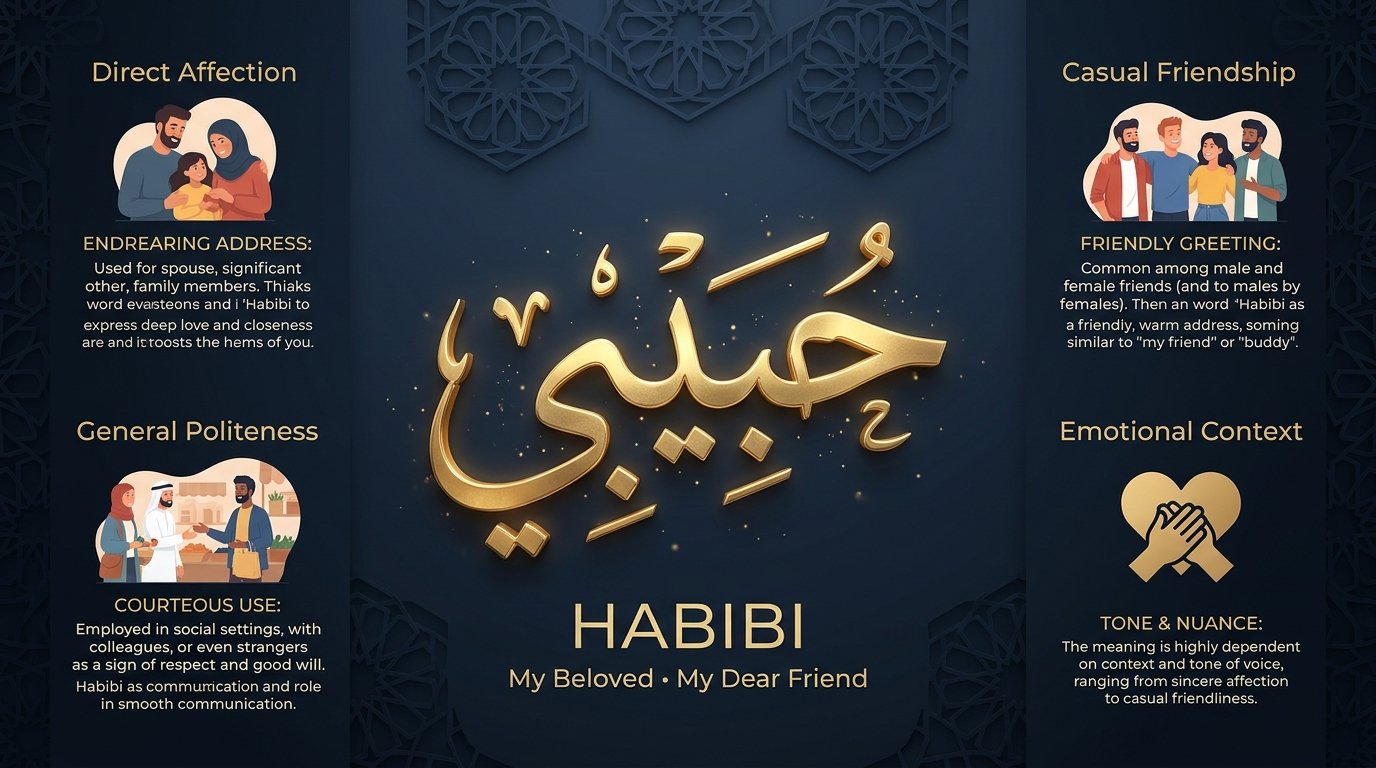
Infographic: The etymology and cultural nuances of the Arabic word ‘Habibi’ (حبيبي).
Linguistic Breakdown: What Does ‘Habibi’ Mean in Arabic?
To understand why El-Sayed’s line landed with such dramatic resonance across the Arab-American diaspora and American pop culture, it helps to examine the linguistic roots and multifaceted social usage of the word Habibi (Arabic: حبيبي).
1. Etymology and Literal Meaning
The word stems from the triconsonantal Arabic root ḥ-b-b (ح-ب-ب), which denotes love, fondness, and deep affection. The root forms the noun habib (حبيب), meaning “beloved” or “darling.” When paired with the Arabic first-person singular possessive suffix -i (ي), the word becomes Habibi—translating literally to “my beloved” or “my love.”
2. Everyday Conversational Usage (The Arabic ‘Buddy’ or ‘Mate’)
While romantically used between partners, in daily life across the Levant, Egypt, and the Gulf, “Habibi” is ubiquitous. It functions much like “my friend,” “brother,” or “mate” in English. Shopkeepers address customers as habibi, cab drivers thank passengers as habibi, and colleagues greet each other warmly with the term.
3. Grammatical Gender: Habibi vs. Habibti
- Habibi (حبيبي): Used when addressing a male (e.g., father, brother, son, friend, or husband).
- Habibti (حبيبتي): Used when addressing a female (e.g., mother, sister, daughter, female friend, or wife).
4. Sarcasm and Irony: The Middle Eastern ‘Bless Your Heart’
Crucially, Arabic speakers frequently employ “habibi” with slight sarcasm or condescending irony—comparable to the Southern American phrase “Bless your heart” or a wry “Listen here, buddy.” When someone makes a flawed assumption or suffers a self-inflicted defeat, an Arabic speaker will often smirk and say, “Look, habibi…”
This subtle linguistic double meaning is precisely what made El-Sayed’s quip to Vice President JD Vance so brilliant: it was simultaneously courteous on the surface yet devastatingly razor-sharp in political subtext.
Who is Abdul El-Sayed? Age, Background, and Credentials
While the “habibi” soundbite captured viral algorithms, Dr. Abdul El-Sayed’s journey to the United States Senate represents one of the most accomplished public service resumes in recent American history.
A Life Rooted in Public Health
At age 30, El-Sayed was appointed Executive Director of the Detroit Health Department, becoming the youngest municipal health commissioner in major American history. Tasked with rebuilding the department from scratch after Detroit’s landmark bankruptcy, he gained national acclaim for testing every school drinking fountain for lead contamination following the Flint water crisis and providing free eyeglasses to thousands of public school students.
After a spirited bid for Michigan Governor in 2018 that galvanized youth voters and union organizers across Michigan, El-Sayed continued his advocacy as a public health professor, author of books like Healing Politics and Medicare for All: A Citizen’s Guide, and health director for Wayne County, Michigan’s largest county.
Who is Abdul El-Sayed’s Wife? Inside His Family Life
Searches for “Abdul El-Sayed wife” spiked alongside political queries following his victory speech. El-Sayed is married to Dr. Sarah Jukaku, MD, a respected board-certified child and adolescent psychiatrist who practices in Michigan.
The couple met as undergraduate students at the University of Michigan in Ann Arbor. Throughout El-Sayed’s demanding public health and political career, Dr. Jukaku has been his foundational partner while building her own distinguished clinical practice treating pediatric and adolescent mental health conditions. They reside in Metro Detroit with their two daughters, Emmaline and Farah.
Did Abdul El-Sayed Win Michigan? Election Analysis
Yes. Abdul El-Sayed secured a decisive victory in Michigan’s U.S. Senate election, successfully holding the seat for Democrats by building a broad, diverse coalition that united suburban moderates, young college voters in Ann Arbor and East Lansing, autoworkers in Flint, and the influential Arab-American communities of Dearborn and Wayne County.
Political analysts attribute his win to a pragmatic focus on kitchen-table economics—lowering prescription drug costs, investing in clean manufacturing jobs, and protecting clean water infrastructure—coupled with an authentic, relatable communication style that resonated far beyond traditional political playbooks.
Frequently Asked Questions (Google Trends Breakdown)
Did Abdul El-Sayed win the Michigan Senate race?
Yes. Dr. Abdul El-Sayed officially won Michigan’s U.S. Senate election, defeating his opponent in a closely watched Rust Belt contest and making history as the first Muslim American elected to the United States Senate.
What does ‘Habibi’ mean in Arabic?
‘Habibi’ (حبيبي) is derived from the Arabic root ‘hubb’ (love) combined with the first-person possessive suffix ‘-i’ (my), meaning ‘my beloved’ or ‘my darling’. In informal Arabic culture, it is broadly used between friends, peers, and acquaintances much like ‘my friend’, ‘brother’, or ‘mate’.
Why did Abdul El-Sayed call JD Vance ‘Habibi’?
During his Detroit victory speech, El-Sayed used ‘habibi’ with sharp, playful irony to highlight that Vice President JD Vance—who had aggressively campaigned against him and questioned his background—is constitutionally required as President of the Senate to administer El-Sayed’s oath of office in January.
Who is Abdul El-Sayed’s wife?
Abdul El-Sayed is married to Dr. Sarah Jukaku, a board-certified child and adolescent psychiatrist. The couple met during their undergraduate studies at the University of Michigan and share two young daughters.
How old is Abdul El-Sayed and where was he born?
Abdul El-Sayed is 42 years old (born October 31, 1984). He was born in Alexandria, Egypt, immigrated with his family as an infant, and grew up in Metro Detroit, Michigan.
What was Abdul El-Sayed’s career before the Senate?
El-Sayed is a Rhodes Scholar, epidemiologist, and medical doctor (Columbia MD, Oxford DPhil). He previously served as the Executive Director of the Detroit Health Department, where he rebuilt Detroit’s public health infrastructure after municipal bankruptcy, and later served as Wayne County’s Health Director.
Is voting over in the 2026 Midterm Elections?
Yes, in-person and mail-in voting for the 2026 Midterms is officially closed across the United States. Election authorities are concluding vote tabulations and final certifications in a handful of tight remaining congressional races.

