
Table of Contents
National capital New Delhi is under heightened security vigilance ahead of Saturday, October 10, following calls by civic groups, the Cockroach Janata Party (CJP), and various student organizations for demonstrations at Jantar Mantar. With extensive digital discourse across social media platforms involving creators and public commentators, the Delhi Police, district administration, and the Supreme Court of India have taken proactive measures to ensure public order, commuter safety, and institutional functionality.
- Delhi Police has denied permission for the proposed October 10 protest at Jantar Mantar, enforcing Section 163 of the Bharatiya Nagarik Suraksha Sanhita (BNSS) across the New Delhi district to maintain public safety and law and order.
- Over 25,000 security personnel, including paramilitary forces and the Border Security Force (BSF), have been deployed across key Delhi-Noida borders and transit hubs.
- The Supreme Court of India observed that transport restrictions must be regulated so commuters do not face undue hardship, advising against blanket shutdowns of metro services.
- Several Delhi schools and colleges have shifted classes online, while Delhi Police issued assurances that bona fide passengers with valid train tickets will not be hindered at railway stations.
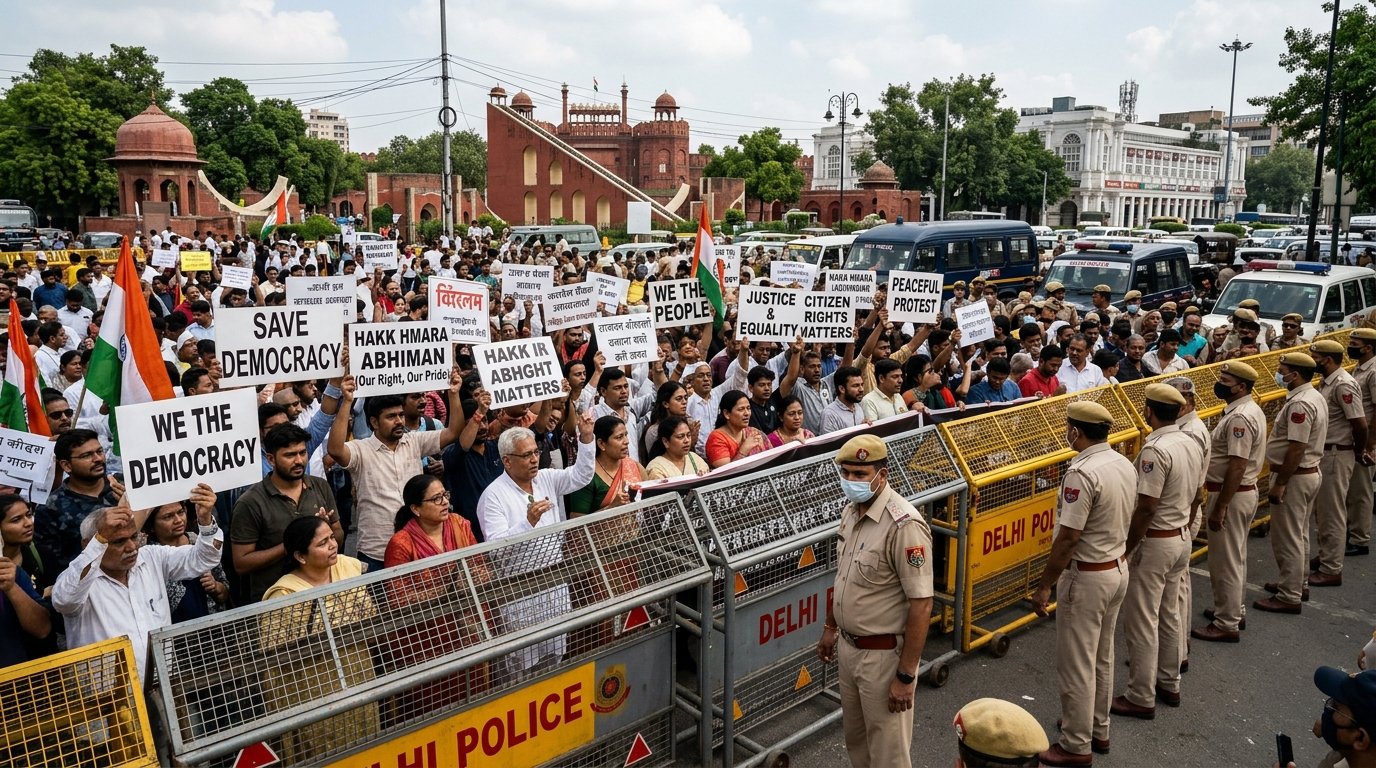
Delhi Police and security personnel maintain vigil across the New Delhi district to protect public order and transit infrastructure.
Administrative Orders: Section 163 BNSS and Police Stance
In an official press briefing, Joint Commissioner of Police (New Delhi range) Nupur Prasad confirmed that Delhi Police has formally rejected the application seeking permission for assemblies at Jantar Mantar on October 10. The senior officer highlighted two primary procedural grounds for the rejection:
- Short Notice Application: The organizers submitted an intimation without adhering to the mandatory 10-day prior notification window required under standard police regulations for demonstrations in Central Delhi.
- Public Order & Compliance Protocols: Authorities noted that previous undertakings during past demonstrations were not strictly observed, necessitating preventive measures to avert public inconvenience and traffic gridlocks.
Consequently, Section 163 of the Bharatiya Nagarik Suraksha Sanhita (BNSS) has been enforced across New Delhi. The statute empowers law enforcement to prevent unauthorized crowd gatherings and maintain uninterrupted municipal services.

Security Deployment and Border Checkpoints
To preserve peace across the National Capital Region (NCR), more than 25,000 security personnel—comprising Delhi Police battalions, paramilitary units, and the Border Security Force (BSF)—have been positioned at strategic intersections. Heavy concrete barricading and multi-layer vehicle screening have been instituted at the Chilla border, Ghazipur border, and Singhu border corridors.
Authorities have reiterated that all interstate vehicles with legitimate business and emergency commuters will be facilitated, while unauthorized convoys intending to stage unpermitted assemblies will be diverted.
Supreme Court Directions on Commuter Convenience & Metro Services
In response to representations regarding potential transport disruptions, the Supreme Court of India intervened to emphasize commuter welfare. A judicial bench directed the administration and Central authorities to ensure that public transit systems—particularly the Delhi Metro network and Indian Railways—are not subjected to indiscriminate shutdowns.
The apex court emphasized that while security arrangements are the legitimate prerogative of law enforcement, administrative decisions must minimize hardship for ordinary citizens, office-goers, students, and passengers with onward domestic and international flights.
In compliance with these observations, Delhi Police assured the public that railway passengers carrying valid boarding passes or train tickets will not face impediments at New Delhi or Hazrat Nizamuddin railway stations. Over 10 CAPF companies and 400 Government Railway Police (GRP) personnel have been stationed at railway hubs to assist travelers.
Public Safety Measures: Schools, Colleges & Aviation Fares
As a precautionary step, numerous prominent schools in Central and South Delhi, including Sardar Patel Vidyalaya, announced that classes from Grade 6 to 12 would transition to online instruction on Saturday. Several universities and higher education institutions have likewise deferred scheduled examinations.
In the civil aviation sector, train rescheduling led to a temporary demand spike on specific air corridors, with spot airfares on routes such as Amritsar to Delhi seeing upward pressure. Airline operators and transit agencies have advised passengers to factor in additional travel buffers when navigating towards the Indira Gandhi International (IGI) Airport.
The Digital Sphere & Creator Engagement
The situation has gained heightened traction across digital platforms like YouTube and X (formerly Twitter). Commentators and digital educators, including Dhruv Rathee, have shared explainers analyzing the role of institutional frameworks, the Election Commission’s functioning, and the democratic balance between lawful petitioning and civic regulations.
Legal scholars and civic observers emphasize that the strength of India’s constitutional democracy lies in the harmonious interaction of active citizenship, administrative vigilance, and judicial oversight—ensuring that civic dialogue occurs strictly within peaceful, lawful, and institutional mechanisms.
Frequently Asked Questions (FAQs)
Why did Delhi Police refuse permission for the October 10 Jantar Mantar protest?
Joint Commissioner of Police Nupur Prasad stated that the intimation was submitted on short notice (against the 10-day procedural requirement) and cited concerns regarding public order and compliance with previous undertakings.
Is Section 163 BNSS enforced in New Delhi?
Yes, Section 163 of the Bharatiya Nagarik Suraksha Sanhita (BNSS) is currently in effect in the New Delhi district, empowering authorities to maintain peace, prevent unlawful assemblies, and regulate traffic movement.
Are Delhi Metro and Indian Railways operational on October 10?
The Supreme Court directed that metro and rail services should remain regulated to avoid commuter disruption. Delhi Police confirmed that passengers carrying valid train tickets will have access to railway stations.
How are schools and educational institutions handling the situation?
Several private and public schools, including Sardar Patel Vidyalaya, have shifted to online classes for Saturday, and universities have rescheduled internal assessments as a precautionary safety measure.

